A warm welcome.
In your language.
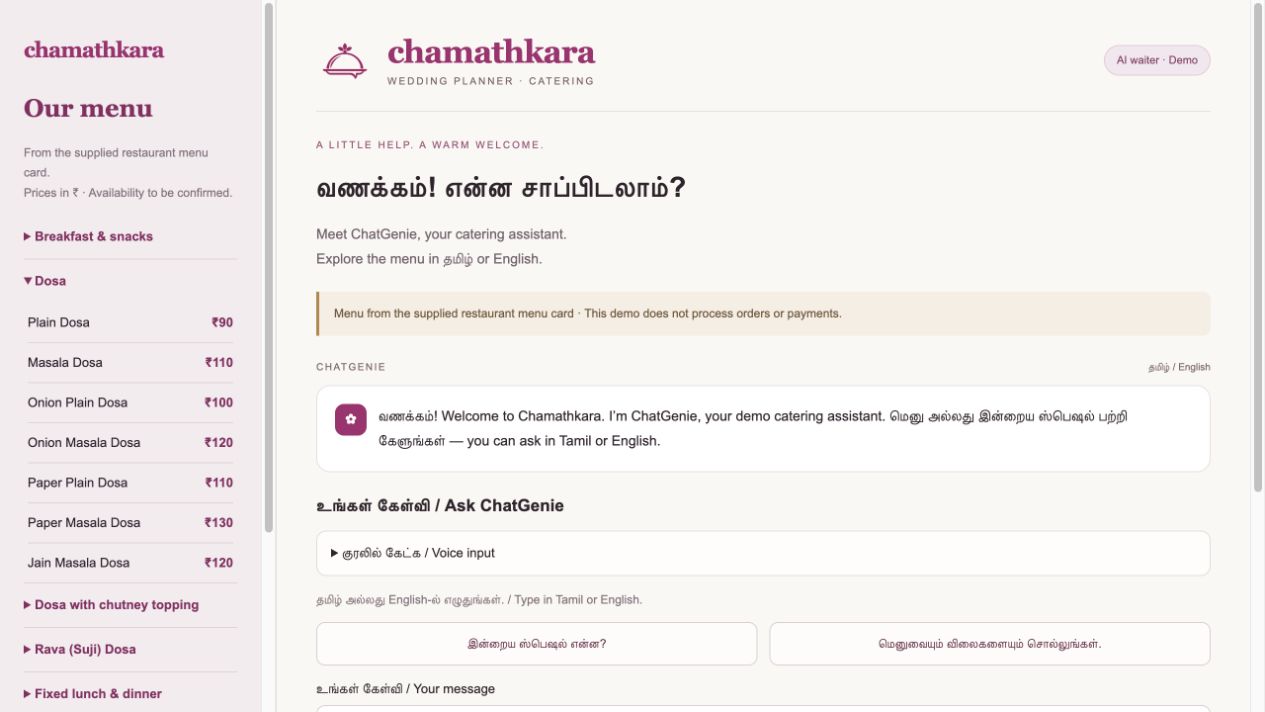
ChatGenie — the AI waiter demo for Chamathkara — makes menu discovery a conversation in தமிழ், English or a mix of both.
Chamathkara · Catering
Conversational UX, bilingual input & AI prototyping
Published demo · No real orders or payments
01 / The opportunity
The original idea was a QR-entry digital waiter: customers could ask about food naturally instead of waiting for every basic menu question to be answered in person.
The prototype focuses on the first part of that journey—understanding the menu and discussing preferences. Ordering, kitchen routing and billing remain future work, not existing functionality.
02 / A conversation, not a form
Open → browse or ask → clarify → continue.
A visible menu sidebar gives customers a reference while the chat supports questions in Tamil or English. Suggested prompts help someone begin without composing a message from scratch.
Short responses and one useful follow-up at a time keep the conversation manageable. Temporary conversation context supports follow-up questions without presenting the chat as a permanent order record.
03 / Key design decisions
Language flexibility
The interface welcomes Tamil and English input, including mixed-language questions, instead of forcing every visitor into one language.
Voice with review
Consent-based recording and transcription offer an alternative to typing. Customers can review and edit converted text before sending it.
A grounded menu reference
The assistant is instructed to use the supplied menu for dishes and prices, not invent offers or preparation times. Availability and ingredients still need staff confirmation.
Honest limits
Visible demo notices explain that no orders or payments are processed. Allergy safety is not guaranteed, and the assistant must not claim to have contacted the kitchen.
04 / Prototype approach
The project includes a Python / Streamlit prototype using LangChain and OpenAI, a supplied menu file, bilingual chat history and an editable voice-input component. The published demo is linked from this case study.
Messages and converted recordings are sent to OpenAI, with a visible privacy notice. API credentials belong on the server, not in the customer interface.
05 / Outcome & next steps
A branded, published catering-assistant demo brings menu browsing, bilingual conversation and voice entry into one experience.
This case study describes a demo, not a deployed restaurant ordering operation. Staff-cost savings, order accuracy and conversion improvements have not been measured.
Production work would require table/session identification, explicit order confirmation, durable order storage, kitchen and billing integration, staff handoff, security controls and real customer testing.